
Artist Spotlight
Ray J’s Security Guard Clashes with Viral Star Aaron The Plumber

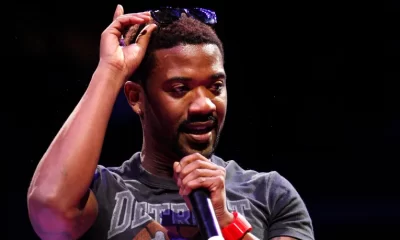
Ray J is no stranger to drama, and recently, it all unfolded at his own home, even though he wasn’t directly involved. A wild scene erupted when his security guard spat on a well known reality star, Aaron The Plumber (whose real name is Aaron Sloan and is also called “The Biggest Turtle”). This altercation happened during a heated moment over something as simple as a phone charger. According to a voice message about the incident, things escalated because Aaron had been drinking, which made the situation more volatile.
Surprisingly, Ray J wasn’t present when this incident occurred, which has left many people questioning whether he knew anything about it happening in his home. Even without being there, Ray J’s name is still connected to the drama since it all took place at his place. He has faced his share of conflicts lately. For example, he recently looked back on a past argument with rapper Kodak Black, acknowledging that he could have handled things better and admitting his previous behavior wasn’t great. He’s trying to be more thoughtful about picking his battles, but the same can’t be said for the people around him.
As for Aaron The Plumber, he’s used to being in the spotlight, so this latest incident is just another chapter in his life as a reality TV star. Whether the fight was a big deal or just blown out of proportion, it’s attracting a lot of attention, and social media is buzzing about it. Meanwhile, Ray J probably has bigger issues on his mind. With ongoing disputes on social media, industry pressures, and reflections on his past fights, a drunken argument over a charger is likely low on his list of concerns. For now, fans wonder if Ray J will speak out about this latest drama or let it fade away like so many other celebrity squabbles.










Artist Spotlight
Fanny Alexandra explores emotional recovery and self-discovery on “Ceasefire”

Not every fight ends a relationship, and there could be long-term emotional damage, with questions about identity, attachment, and the difficult path to moving on. “Ceasefire” is a ghostly alternative rock ballad in which Fanny Alexandra navigates difficult terrain, exploring emotional dependency and the search for selfhood after a toxic relationship.
“Ceasefire” is full of sad melodies and hints of atmospheric rock, making it a dark, cinematic listen. The song’s alt-rock pivot provides an emotionally charged foundation, and it’s about the internal battle, especially when your identity has been so tied to another person.
Fanny Alexandra’s ethereal vocal approach suits the song, lending real emotional weight to the exploration of self-loss and internal tension. “Ceasefire” is a reflective track, with atmospheric instrumentation and deeply personal songwriting that capture feelings that can linger long after a tough chapter closes.
It’s about finding yourself again, and its emotional arc moves from openness and dependence to the hard-earned discovery that personal freedom is more than just walking away. Fanny Alexandra’s love for dark, emotional alternative music inspired “Ceasefire.” Her art is about intimate storytelling, cinematic atmosphere, and making music that explores the quieter struggles people tend to keep inside. In this record, she turns the fallout from a toxic relationship into a meditative reflection on the long road to selfhood.
Artist Spotlight
Stephani Ezatoff honors Elvis Presley’s legacy on powerful new single “Run On”

Gospel-rooted music carries emotional weight, especially when it explores the tension between faith, love, and accountability. With “Run On,“ Stephani Ezatoff combines these into a rock version of Elvis Presley’s famous 1967 version of the traditional African American gospel hymn.
Ezatoff doesn’t simply retrace history but surrounds it with a unique atmosphere of powerful vocals and an ever-intensifying arrangement. The single was recorded at the legendary Sound Shop Studio on Music Row in Nashville and has an interesting connection to Elvis Presley’s own recording history. The studio session was located a stone’s throw from RCA’s Studio B, where Elvis recorded his own version of the hymn.
This adds another layer of meaning to an already meaningful release, placing Ezatoff’s take within Nashville’s musical heritage. Aaron Minick’s arrangement plays on the contrast between divine love and judgment, which is central to the track’s identity. The production builds slowly, and the song becomes a dramatic, cinematic experience. Ezatoff also makes a unique contribution by singing all the vocals herself.
The story of how the recording was made adds to the poignancy of “Run On.” This is one of the last releases made at Sound Shop Studio, which hosted artists like Dolly Parton and Brenda Lee, but closed for good just days after the session. For Stephani Ezatoff, “Run On“ is a vital link between generations of musicians preserved in a recording that’s a piece of Nashville history.

-

 Album Review3 days ago
Legends of the Seven Golden Vampires explore healing and personal growth on “The Pumphouse of Broken Dreams” [album]
-

 Artist Spotlight3 days ago
Ricky’s Rebel Rabble honor family and remembrance through “Molly”
-

 Artist Spotlight4 days ago
T1M1 featuring Keybeaux confront artificial creativity with latest release “Hip Slop”
-

 Artist Spotlight3 days ago
for KING & COUNTRY celebrate faith and everyday joy on “the most beautiful colours”
-

 Album Review3 days ago
Brynja Rán finds clarity in complicated relationships on “Unblurred” [album]
-

 Artist Spotlight4 days ago
Lil Bales unveils a love bomb on latest release “Rust”
-

 Artist Spotlight1 day ago
Boy Sim explores heartbreak and self-deception on “Cloud Nine”
-
 Artist Spotlight4 days ago
Terry Ennison examines faith, illusion, death, and transformation on latest release “Testimonial”